Title here
Summary here
import { decodeWeight, decodeFirstN, numericView, computeStats } from "@wetron/core";
import type { WeightSource, WeightStats } from "@wetron/core";
ModelGraph.weights is absent when the parser exposes no payloads. Otherwise it identifies available bytes or required external files.
type ModelWeights =
  | { readonly kind: "available"; readonly source: WeightSource }
| { readonly kind: "external"; readonly format: "savedmodel" | "onnx" };interface WeightSource {
readonly totalBytes: number;
get(name: string): Uint8Array | undefined;
}get(name) returns raw little-endian bytes for the named initializer or undefined if the name is unknown. The slice is a view into the original parser buffer - no copy is made.
| Format | graph.weights state |
|---|---|
| ONNX | available for inline payloads; external for external data |
| TFLite | available from the referenced buffer table |
| GGUF | available for supported little-endian encoded payloads |
SavedModel (saved_model.pb) | external until attachCheckpointToGraph, then available |
Keras / TorchScript / ExecuTorch / keras_metadata.pb | absent unless a format-specific loader attaches bytes |
function decodeWeight(
  bytes: Uint8Array,
  dtype: string,
  shape: readonly number[],
): Float64Array | Int32Array | Uint32Array | BigInt64Array | BigUint64Array | null;
Decodes the entire byte slice into a typed array sized to shape. Returns null for unknown dtypes.
Output element kind:
Float64Array for floating-point scalar types, GGML F16 / F32 / BF16 / F64, and GGML Q4_0Int32Array for signed integer types, uint8, uint16, bool, and GGML I8 / I16 / I32Uint32Array for uint32BigInt64Array or BigUint64Array for 64-bit integer typesOther GGML quantization formats return null until a decoder is implemented. Their encoded bytes remain available through graph.weights.source when kind === "available".
function decodeFirstN(
  bytes: Uint8Array,
  dtype: string,
  n: number,
): Float64Array | Int32Array | Uint32Array | BigInt64Array | BigUint64Array | null;
Same kind mapping as decodeWeight. Decodes the first n elements (or fewer if the byte slice is shorter). Use this for previews of large tensors.
function computeStats(values: NumericWeight): WeightStats;Pass decoded values through numericView() first. Number-backed arrays retain their identity; bigint arrays widen once to Float64Array.
interface WeightStats {
  readonly count: number;
  readonly min: number;
  readonly max: number;
  readonly mean: number;
  readonly std: number;
  readonly zeros: number;
  readonly histogram: readonly number[]; // length 12, fixed-width bins between min and max
  readonly heatmap: readonly number[]; // length 128, 16 cols x 8 rows, mean of consecutive chunks
  readonly chunkSize: number; // values averaged per heatmap cell
}
The histogram has 12 bins between min and max. When min === max, the entire count lands in the middle bin. The heatmap is 16 × 8 = 128 cells; each cell averages chunkSize = max(1, floor(count / 128)) consecutive values.
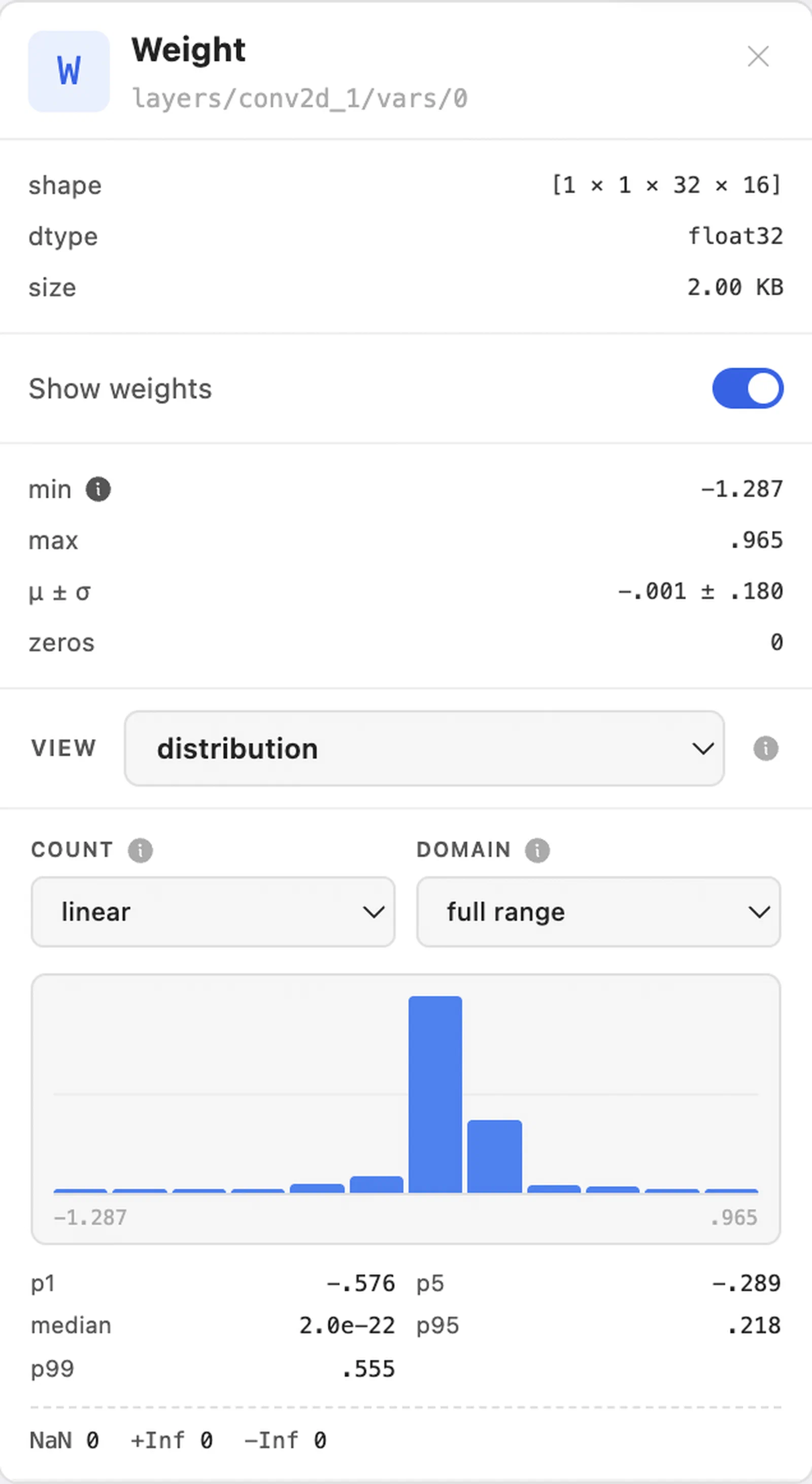
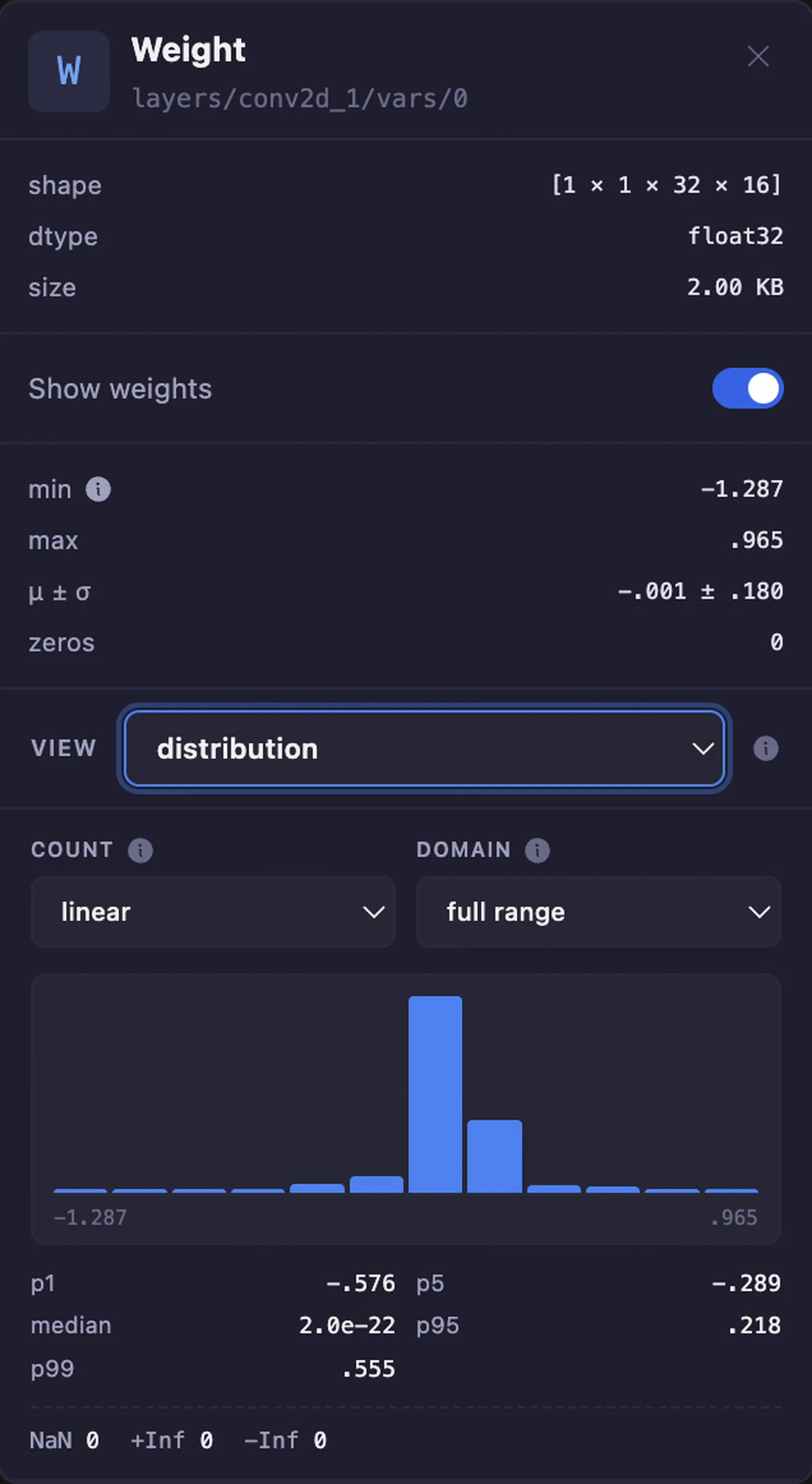
The renderer packages decode a tensor once per selection and hand the result to every inspector through context - useWeightInspection() in @wetron/react, getWeightInspection() in @wetron/svelte. Both return this shape.
type WeightInspectionData = {
  readonly tensor: {
    readonly name: string;
    readonly shape: readonly number[] | null;
    readonly dtype: string | null;
    readonly order?: TensorOrder;
  };
} & (
  | {
      readonly status: "deferred" | "external" | "unavailable";
      readonly bytes: null;
      readonly values: null;
      readonly stats: null;
    }
  | { readonly status: "unsupported"; readonly bytes: Uint8Array; readonly values: null; readonly stats: null }
  | {
      readonly status: "ready";
      readonly bytes: Uint8Array;
      readonly values: DecodedWeight;
      readonly numeric: NumericWeight;
      readonly stats: WeightStats;
    }
);
status | Meaning |
|---|---|
deferred | The “Show weights” toggle is off. Models over 20 MB start this way. |
external | The checkpoint or external data file is not attached yet. |
unavailable | No bytes are registered under this tensor name. |
unsupported | Bytes exist, but decodeWeight has no decoder for the dtype. |
ready | Decoded. values, numeric, and stats are populated. |
values holds the decoded array as decodeWeight returned it; numeric is the numericView() of the same data, widened to Float64Array for bigint dtypes. order is "col-major" for GGUF payloads and absent for row-major formats - inspectors that slice along an axis have to honour it.
import { loadSavedModelWeights, loadSavedModelWeightsFromUrls, attachCheckpointToGraph } from "@wetron/savedmodel";
import type { LoadedCheckpoint } from "@wetron/savedmodel";

async function loadSavedModelWeights(indexFile: File, dataFile: File): Promise<LoadedCheckpoint>;

async function loadSavedModelWeightsFromUrls(indexUrl: string, ...dataUrls: string[]): Promise<LoadedCheckpoint>;

interface LoadedCheckpoint {
  readonly weights: WeightSource;
  readonly metas: ReadonlyMap<string, CheckpointMeta>;
  readonly fullNameToKey: ReadonlyMap<string, string>;
}

interface CheckpointMeta {
  readonly dtype: string;
  readonly shape: readonly number[];
  readonly shardId: number;
  readonly offset: number;
  readonly size: number;
}

function attachCheckpointToGraph(graph: ModelGraph, loaded: LoadedCheckpoint): ModelGraph;
loadSavedModelWeights reads the SavedModel checkpoint pair (variables.index + variables.data-XXXXX-of-YYYYY) and returns a WeightSource keyed by the SSTable key. metas retains each parsed entry’s dtype, shape, shard, byte offset, and byte size, including the _CHECKPOINTABLE_OBJECT_GRAPH entry when present.
loadSavedModelWeightsFromUrls is the URL-based variant. Pass the index URL plus one data-shard URL per shard, in shard order (shard 0, 1, …). All URLs are fetched in parallel. Server must allow CORS (Access-Control-Allow-Origin). Throws ParseError if any response is not ok.
attachCheckpointToGraph re-keys the loaded WeightSource by graph node name. It walks each VarHandleOp node, resolves its shared_name against the checkpoint’s object graph (_CHECKPOINTABLE_OBJECT_GRAPH) or directly against <shared_name>/.ATTRIBUTES/VARIABLE_VALUE, and returns a graph with weights.kind === "available". weights.source.get(nodeName) returns the matching tensor bytes.
parseSavedModel returns { kind: "external", format: "savedmodel" } when a checkpoint is required.
import { loadOnnxExternalWeightsFromUrl } from "@wetron/onnx";

async function loadOnnxExternalWeightsFromUrl(modelBytes: Uint8Array, baseUrl: string): Promise<WeightSource>;
For ONNX models whose initializers use data_location = EXTERNAL, fetches each unique external file once from ${baseUrl}/${location} (where location is the filename recorded in the initializer’s external_data entries) and returns a WeightSource that slices the fetched buffers by initializer name. Files are fetched in parallel; initializers sharing a location share one buffer.
Attach the returned source with { ...graph, weights: { kind: "available", source } }. If any initializer is external, parseOnnx reports the model as external rather than exposing a partial source for its inline initializers.
Returns an empty WeightSource (totalBytes: 0, get() always undefined) if the model has no EXTERNAL initializers. Throws ParseError if any response is not ok. CORS rules from parseModelFromUrl apply.
import { parseModel } from "@wetron/core";
import { decodeFirstN, computeStats } from "@wetron/core";

const graph = await parseModel(bytes, file.name);
const weightBytes = graph.weights?.kind === "available" ? graph.weights.source.get("conv1.weight") : undefined;
if (weightBytes) {
  const preview = decodeFirstN(weightBytes, "float32", 4096);
  if (preview && preview instanceof Float64Array) {
    const stats = computeStats(numericView(preview));
    console.log(stats.min, stats.max, stats.mean, stats.std);
  }
}